Contingency Planning for Drone Operations: What to Do When the Plan Fails
The Plan Is Never the Whole Plan
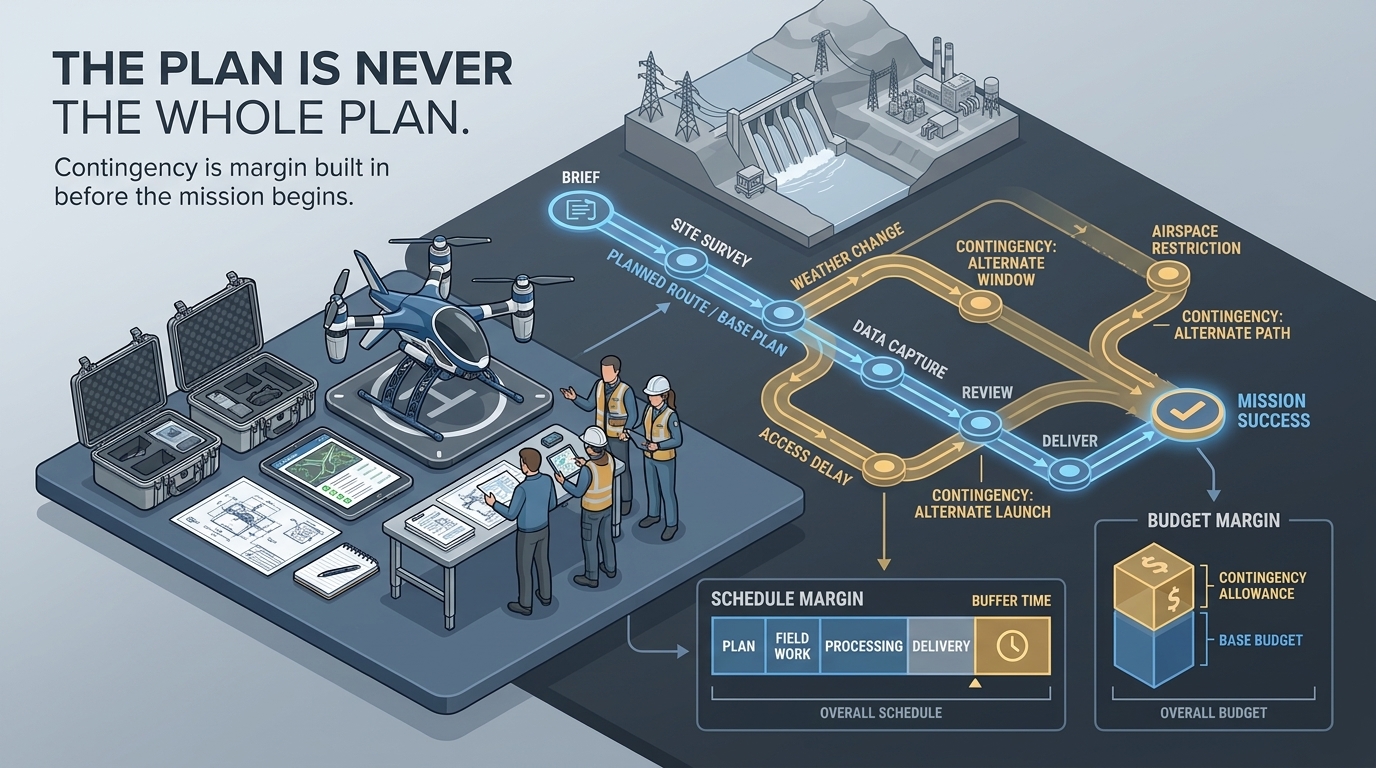
Contingency planning is not a backup plan. It is margin, built in before the work starts, for the moment when the paper plan meets reality. That margin shows up in two places most operators do not connect: the schedule, and the budget.
When a project is bid too tight, with no buffer for anything going wrong, the pressure starts before the crew ever reaches the site. Then something happens, because on some percentage of missions, something always does. Without contingency built into the budget or the schedule, that pressure turns into urgency. Urgency turns into shortcuts. And over twenty five years in this industry, I have seen that shortcuts are where mistakes get made.
Contingency planning means thinking through what can go wrong before the work starts, pricing and scheduling for it honestly, and then having enough margin in the field to adapt when something outside the plan shows up anyway.
This is not only a lesson for complex federal missions. A simple marketing shoot over a congested area with tight airspace restrictions can carry the same risk as a dam inspection if contingency was never built into the plan. The complexity of the site changes. The need for margin does not.
Security Coordination on Federal Sites
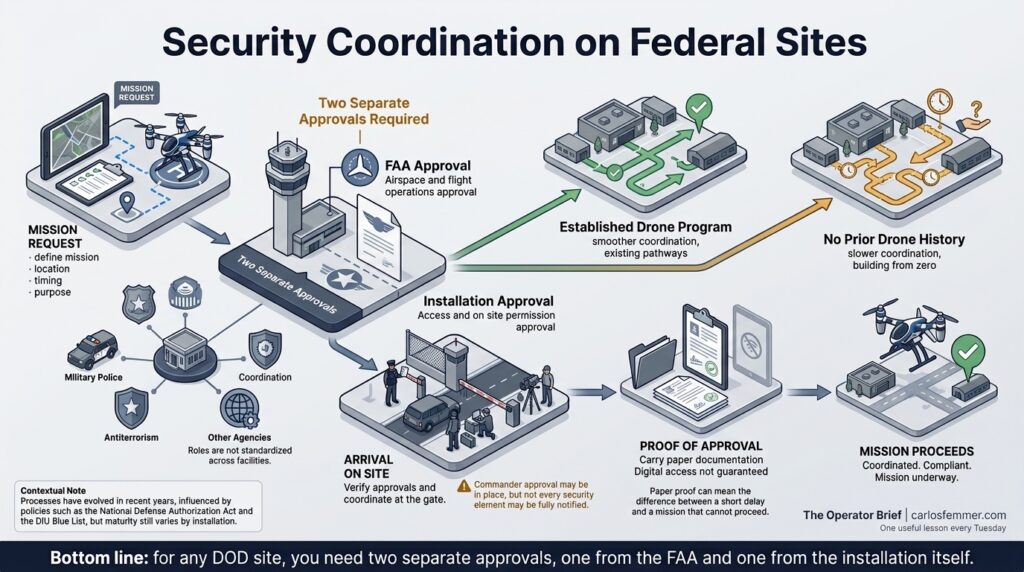
Security coordination on federal sites is not one process. It is many processes, and they are not always consistent with each other. Drone operations on defense sites have evolved significantly over the past several years, shaped by policies including the National Defense Authorization Act and the DIU Blue List, but adoption and process maturity still vary base to base. One base with an established drone program can coordinate an approval smoothly between the FAA and the facility. Another base, with no prior drone history, is starting that same coordination from zero, even when the mission and the airspace request look identical on paper.
Getting the initial approval is one layer. Coordinating it on the ground, once you arrive, is another. Every base handles security differently. Military police, antiterrorism offices, and other agencies may all have a role, and the division of responsibility is not standardized across facilities. On one mission, the commander had signed off and the approval was solid, but not every security element on base had been fully notified. The crew was stopped to verify records before work could continue.
That is why we never rely on digital approval alone. If you are stopped, the first thing asked for is proof of approval, and digital access is not guaranteed on every base. Paper documentation, carried in hand, has been the difference between a short delay and a mission that could not proceed. Everything described here reflects publicly available process knowledge, not sensitive or controlled information. The bottom line for any DOD site is straightforward: you need two separate approvals, one from the FAA and one from the installation itself.
Wildlife in the Field
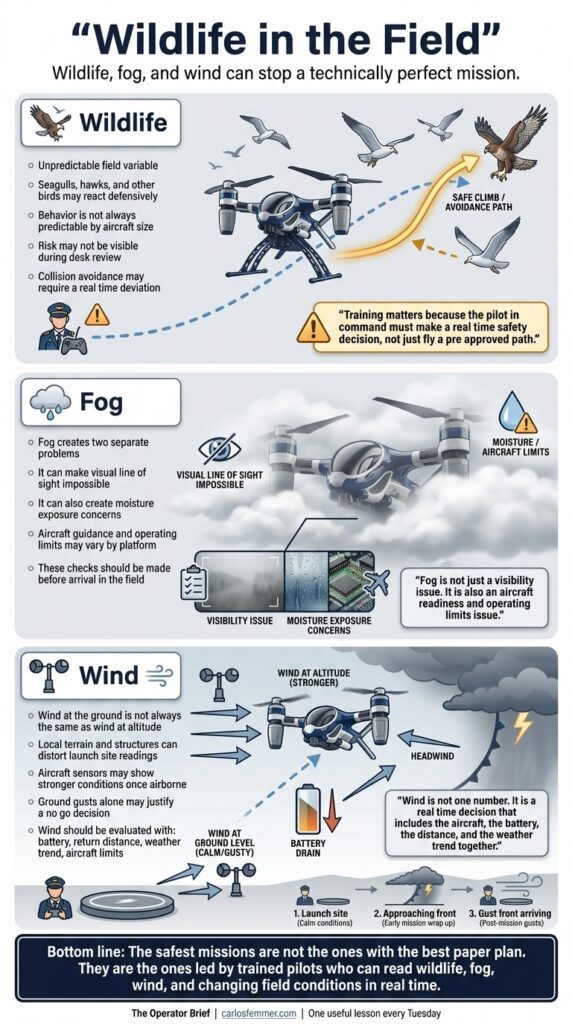
Weather is not the only environmental factor with the power to stop a technically perfect mission. In more than twenty years of flying across different regions, wildlife has proven to be one of the most unpredictable variables. A larger aircraft, with a distinct sound profile, has triggered defensive behavior from seagulls on the West Coast. A mid sized aircraft has drawn the same response from hawks in the Gulf Coast region. The response is not always predictable by aircraft size alone, and it is rarely something a desk review catches before the crew is airborne.
On one mission, aggressive birds began diving at the aircraft from below. The safe response, in that moment, was a brief climb above the standard four hundred foot ceiling, an emergency deviation made for collision avoidance, followed immediately by moving clear of the area and descending back into controlled airspace. Part 107 allows for exactly this kind of judgment call when safety requires it. It is not a routine maneuver. It is the reason the pilot in command has to be trained to make a real time decision, not just fly a pre-approved path.
Fog
Fog introduces two separate problems, not one. Part 107 requires the pilot to maintain visual line of sight with the aircraft. Dense fog can make that legally impossible before it makes it practically difficult, so the flight is not a judgment call at that point, it is simply not an option. Fog and moisture also raise a question about the aircraft itself. Different platforms carry different ingress protection ratings, and manufacturer guidance on operating in fog or light rain varies by aircraft. That is a check worth making before you ever reach the field, not during a delay. you need to understand the operating limits / parameters of the drone you plan to fly.
Wind
Wind is less predictable than most pilots expect, because ground conditions and flight altitude are not the same environment. An anemometer reading at the launch site reflects the wind around that specific location, including whatever buildings or terrain are shaping it locally. Climb into a different altitude band and the wind can be a different problem entirely. On more than one mission, ground conditions were within limits at launch, and once airborne, the aircraft’s own sensors flagged wind approaching its operating threshold and recommended bringing it down. On other occasions, a gust on the ground alone was enough to call a no go before the aircraft ever left the case.
The clearest example was a front moving in. Conditions looked deceptively calm, the kind of lull that shows up right before a system arrives. Predictive weather data showed the front approaching, so the mission wrapped early. About thirty minutes later, a gust front came through hard enough that flying through it would have been difficult to manage, particularly with limited battery remaining and distance to cover back to the pilot. Reading the aircraft, the wind, the battery, and the return distance together, as one decision, is what training is actually for. It is not a single rule. It is a real time judgment call, made with every variable in view at once.
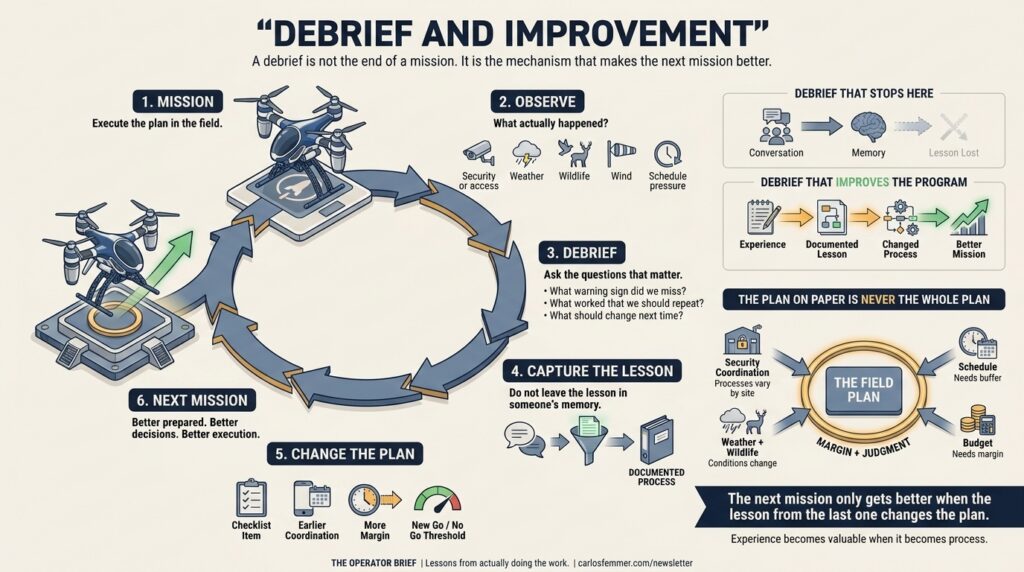
Debrief and Improvement
Every one of these moments produced the same next step. We debriefed. A debrief is not a formality. It is where the actual improvement happens. What warning sign existed that we did not act on in time. What would we build into the plan differently next time. What worked, that we should keep doing exactly the same way. None of this gets captured if the debrief only lives in someone’s memory. The lesson has to turn into a change in the plan itself, a checklist item, an earlier phone call, a different go or no go threshold. That is the only reason the next mission goes better than the last one.
The Plan on Paper Is Never the Whole Plan
Security coordination varies by site. Weather and wildlife do not read the forecast the way we do. Budgets and schedules built without margin turn ordinary field surprises into pressure, and pressure is where mistakes happen. The pilots and program leaders who last in this work are not the ones with the most detailed plan. They are the ones who built room into that plan for what the plan could not predict, and who got better at it every time something happened anyway.