How to Become a Professional Drone Pilot in 2026: The Complete Career Roadmap
Becoming a professional drone pilot in 2026 requires five sequential stages: earning your FAA Part 107 certificate, building documented flight hours in a defined vertical, specializing in a high-value commercial niche (inspections, survey, construction, or public safety), securing enterprise-grade insurance and certifications, and operating either as an embedded enterprise operator or an independent service provider with proven systems. The pilots who succeed treat it as a structured career with measurable milestones — not a hobby that will monetize itself.
Most won’t make it past Stage 2. This guide explains why — and how to be the exception.
Why This Guide Is Different
I lead 60+ FAA Part 107 pilots and a 50+ aircraft fleet at HDR Engineering. Our work has included drone operations at the Golden Gate Bridge, Pearl Harbor, the Grand Canyon, Vandenberg Space Force Base, and West Point. Our clients include Fugro and John Chance Land Surveys. I am writing this from the field — from active program leadership in 2026 — not from memory of how this industry looked five years ago.
If you are reading other career guides written by people who got their Part 107 last year and now consider themselves authorities, close those tabs. The drone industry has matured. The path that worked in 2018 — buy a drone, get certified, post on Instagram, get hired — is closed. The system that works now is different, harder, and more rewarding for the pilots who follow it.
The 2026 Reality You Need to Understand
Three things have changed that every aspiring professional pilot needs to internalize before they spend a dollar.
The market is saturated at the bottom and starved at the top. The FAA has issued well over 400,000 Part 107 certificates. The supply of certificate holders willing to fly real estate photos for $150 has never been higher. The supply of operators who can deliver engineering-grade deliverables under enterprise contracts has never been more constrained. The bottleneck is no longer access to the certificate. It is the gap between certificate holder and professional operator.
AI is no longer optional. In 2026, drone work that does not integrate AI workflows for flight planning, image analysis, defect detection, and deliverable generation is being underbid by operators who do integrate them. The pilot who can fly is being replaced by the operator who can fly, process, analyze, and deliver in one continuous workflow. AI is the new baseline, not a competitive advantage.
BVLOS is finally moving. The FAA’s Part 108 framework is reshaping what professional operations look like. Operators who position themselves around BVLOS-ready operations — extended missions, automated workflows, network-based airspace integration — will be ahead of the curve when full implementation arrives. The pilots still focused on visual line-of-sight hobby flying are being passed.
If those three realities feel intimidating, good. They are the filter. The pilots who take them seriously are the ones building careers.
The Operator Stack: Your Five-Stage Roadmap
I have hired, trained, and managed enough pilots to see the same pattern repeatedly. There are five stages every professional drone pilot moves through, and each stage has a specific outcome you must achieve before advancing. Skip a stage and you stall. Try to operate above your stage and you fail visibly. Sequence the stages correctly and you compound.
Stage 1: Legal Foundation (Months 1–2)
The Part 107 certificate is the floor of this profession, not the ceiling. It is the price of admission. Treat it that way.
What Stage 1 requires:
- Pass the FAA Part 107 Aeronautical Knowledge Test
- Register your aircraft and comply with Remote ID requirements
- Understand airspace classifications, weather decoding, and operational limitations
- Build the legal habits that will protect you at scale (logs, maintenance records, pre-flight documentation)
What Stage 1 does not give you:
- Any meaningful flight skill
- Any client
- Any deliverable capability
- Any business
Pilots who get stuck at Stage 1 are the ones who treat the certificate as the goal. The certificate is a gate. Walk through it, do not sit on it.
Time to complete: 30 to 60 days for most candidates studying part-time.
Stage 2: Flight Hours and Portfolio (Months 3–9)
This is where 80 percent of aspiring professionals quietly stall and never recover.
The work in Stage 2 is unglamorous and unpaid (or underpaid). You are building three things simultaneously:
- Real flight hours. Not simulator hours. Not test flights. Documented operational hours under varied conditions — wind, low light, complex environments, mission planning under constraints.
- A defensible portfolio. Not Instagram footage. Engineering-style deliverables. A site survey you completed. A bridge inspection you photographed. A construction progress report you generated. The kind of work a procurement officer can evaluate.
- Operational discipline. Pre-flight checklists you actually use. Post-flight logs you actually maintain. Maintenance records that exist. The boring infrastructure of professionalism.
The mistake at this stage is chasing client work before you have any of those three. Pilots email me asking how to land enterprise clients when they have flown 12 hours in their entire career and have a portfolio of golf course flyovers. The answer is: you don’t, and you shouldn’t. Build the foundation first.
Target outcomes by end of Stage 2: 100+ documented flight hours, a portfolio of at least three engineering-style deliverables in your chosen vertical, and operational systems you can show a hiring manager.
Stage 3: Vertical Specialization (Months 10–18)
Generalist drone pilots earn generalist drone pilot money. Specialists earn enterprise rates.
By Stage 3 you must commit to a vertical. The high-value commercial verticals in 2026 are:
- Engineering inspections (bridges, towers, pipelines, power transmission, dams)
- Survey and mapping (LiDAR, photogrammetry, GIS deliverables for AEC firms)
- Construction documentation (progress monitoring, stockpile measurement, site surveying, BIM integration)
- Public safety and emergency response (search and rescue, accident reconstruction, tactical operations)
- Energy (solar farm thermal inspection, wind turbine inspection, oil and gas)
Each vertical has its own equipment requirements, sensor stack, software workflow, regulatory considerations, and client expectations. You cannot be excellent in all of them. Pick one. Master its specific deliverables, software, sensors, and client language.
The pilots I hire have made a clear choice. They can speak the language of the vertical they serve. They know what their clients actually receive at the end of a project — not just the data they capture, but the report, model, or analysis the client uses to make decisions.
Stage 3 outcome: You are demonstrably the operator clients call when they need a specific kind of work done in a specific industry.
Stage 4: Enterprise Operator (Months 18–36)
This is the stage where the income changes meaningfully — and so does the work.
Operating at enterprise level requires:
- Insurance that meets enterprise contracts (typically $1M to $5M aviation liability minimum, with hull coverage on the equipment)
- Documented Standard Operating Procedures that match how serious clients actually run safety
- Vendor qualification capability — the ability to fill out the procurement and security documentation that enterprise clients require before they will engage you
- Data security and chain-of-custody protocols for sensitive deliverables
- Past performance documentation at scale, not just one-off projects
Most independent pilots never reach this stage because the infrastructure required to operate here is not the same skill set as flying a drone. It is business infrastructure. It is paperwork. It is systems.
The pilots who reach Stage 4 split into two paths from here. Some embed inside larger organizations as in-house operators or program leads. Others build independent service businesses serving enterprise clients directly. Both paths are viable. Neither is easy.
Stage 5: Program Leader or Business Owner (Year 3+)
The top of the stack is no longer about flying. It is about systems.
At Stage 5 you are either:
- Leading a drone program inside a larger enterprise — managing pilots, fleet, SOPs, client relationships, and program economics. This is what I do at HDR. The job is 5 percent flying and 95 percent leadership.
- Operating an independent drone services business — managing your own pilots, sales pipeline, equipment, contracts, and growth. The job is 5 percent flying and 95 percent business operation.
Either way, the operator who reaches Stage 5 has stopped thinking of themselves as a drone pilot. They are now a leader, a builder, an operator of a system. The drone is one tool in that system.
This is where elite earning sits. This is where industry influence is built. This is where careers — not jobs — are made.
The Skills Gap Most Pilots Refuse to Address
After managing 60+ pilots across multiple programs, I can tell you exactly what separates the operators who advance from the ones who plateau. It is not flight skill. Flight skill is necessary but not sufficient.
The operators who advance have these skills, in order of importance:
Written and verbal communication. They can write a clean field report. They can speak professionally in a client kickoff meeting. They can explain technical findings in language a project manager understands. The pilots who plateau cannot do these things, and they refuse to learn.
Data fluency. They understand what their drone captured, what software is doing to it, and what the client receives at the end. They can troubleshoot a flight plan, a point cloud, an orthomosaic, or a report. The pilots who plateau hand off a memory card and call themselves done.
Self-management. They show up on time, prepared, with the right gear, with permits in hand. They keep their own records. They manage their own training. The pilots who plateau need to be managed.
Business literacy. They understand how their work fits into a project budget, a client’s outcome, and a vendor relationship. The pilots who plateau treat the flight as the deliverable. It is not. The deliverable is the value the client receives.
If those four skills sound like the skills of any professional in any industry — yes. That is the point. Drone pilots who treat themselves as professionals get treated as professionals.
What I Look For When I Hire
When I add someone to a 60-pilot program, the test is not whether they can fly. I assume they can fly. The test is whether they can be trusted with a project that matters.
The five things I look for, in priority order:
- A documented track record. Not stories. Records. Hours logged, projects completed, deliverables produced.
- Demonstrated specialization. Generalists fall to the bottom of the stack immediately. Specialists rise.
- Clean operational habits. A pilot who does not maintain their own logs and equipment will not maintain ours.
- Communication under pressure. A field operator must be able to explain to a client, in real time, why a flight is being scrubbed or rescheduled. This is harder than it sounds.
- Coachability. I want operators who can absorb feedback, integrate it, and improve. Pilots who already know everything are pilots I do not hire.
If you cannot show me those five things, the certificate on your wall does not matter to me — and it will not matter to any other enterprise hiring manager.
The Mistakes That Keep Pilots Stuck at Stage 2
In ten years of leading drone programs, I have watched the same mistakes repeat. If any of these describe you, fix them now:
- Buying gear before earning the right to use it. A pilot with 40 hours and a $20,000 LiDAR rig is a liability. Earn the gear by earning the work.
- Pricing on cost instead of value. Enterprise clients do not buy on price. They buy on confidence. Underpricing signals you do not understand the work.
- Confusing social media with portfolio. Instagram footage is not a portfolio. A documented project deliverable is.
- Refusing to specialize. “I can fly anything” is the marketing of someone who cannot fly anything specific well.
- Treating training as one-time. Regulations evolve. Software evolves. Client expectations evolve. The pilots who stop learning are the pilots who get replaced.
- Ignoring the business side. The drone is a tool. The business is the work. Pilots who hate the business side never escape the bottom of the market.
Your 90-Day Action Plan
If you are starting from zero today, here is what the next 90 days look like:
Days 1–30: Certification and infrastructure. Begin Part 107 study. Set up an LLC or sole proprietorship structure. Open a separate bank account. Establish basic operational documentation — flight logs, maintenance logs, pre-flight checklists. Choose your vertical and start studying its language and deliverables.
Days 31–60: Pass the test and start flying intentionally. Take and pass the Part 107 exam. Begin documented flight time in conditions and environments that match your chosen vertical. Build your first deliverable — even unpaid, even practice — that matches what your future clients will buy. Start producing one piece of professional content per week (LinkedIn article, case study, or written report).
Days 61–90: First deliverable, first client, first systems. Complete your first portfolio-grade project, paid or unpaid. Build the SOPs you will need at Stage 4 starting now, while the program is small and easy to systematize. Establish your insurance baseline. Identify three companies you would like to work for or with — and begin a long, professional, real conversation with people inside them. Not a cold email. A real relationship.
By Day 90, you should be at the early end of Stage 2 with the systems of someone preparing for Stage 3. That is the pace.
The Discipline Behind the Career
I am going to close on something most career guides will not tell you.
Becoming a professional drone pilot in 2026 is a multi-year project. It will require consistent action across hundreds of days. The pilots who succeed are not the most talented. They are the most disciplined. They show up daily. They keep records when no one is watching. They learn when no one is grading them. They build systems when shortcuts are available.
I have written extensively about this elsewhere — discipline is a professional skill, not a personality trait. The pilots who treat their development as a daily system, with measurable inputs over a long enough horizon, end up at Stage 4 and Stage 5. The pilots who do not, end up writing comments on someone else’s article five years later about how the industry got too crowded.
Elite performance is a system, not a talent. The drone industry rewards the operators who understand that.
Frequently Asked Questions
How long does it take to become a professional drone pilot?
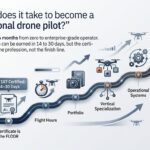
Realistically, 18 to 36 months from zero to enterprise-grade operator. Part 107 certification can be earned in 14 to 30 days, but the certificate is the floor of the profession, not the finish line. Building the flight hours, portfolio, vertical specialization, and operational systems required to operate professionally takes a sustained multi-year effort.
How much do professional drone pilots make in 2026?
Compensation varies significantly by stage and specialization. Entry-level commercial pilots typically earn $40,000 to $60,000 in salaried positions or $50 to $150 per hour as independents. Specialized inspection and survey operators commonly earn $75,000 to $120,000. Enterprise operators and program leaders earn $120,000 to $200,000 or more, often with significantly higher compensation in independent business ownership at scale.
Do I need a college degree to become a professional drone pilot?
No, the FAA Part 107 certificate has no degree requirement. However, some enterprise verticals — particularly engineering, survey, and government contracting — increasingly favor candidates with degrees in surveying, GIS, engineering, or related technical fields. A degree is not required but specialized technical knowledge in your chosen vertical is.
Is it too late to get into the drone industry in 2026?
The opposite. The market is saturated at the bottom (hobby and entry-level commercial pilots) and starved at the top (enterprise-grade operators). The opportunity in 2026 is not for another generalist Part 107 holder. It is for operators willing to specialize, professionalize, and operate at the enterprise level where demand exceeds qualified supply.
What is the best way to get started as a professional drone pilot?
Begin with the FAA Part 107 certification, but do not stop there. Choose a high-value commercial vertical immediately, build documented flight hours and portfolio-grade deliverables in that vertical, and develop the operational systems (insurance, SOPs, documentation, business infrastructure) that enterprise clients require. The path forward is structured and sequential, not improvised.
What equipment do I need to start?
Less than you think for Stage 1 and Stage 2. A reliable Part 107-compliant aircraft with a quality camera, a tablet for flight planning, and basic post-processing software is sufficient for the first 100 to 200 flight hours. Specialized equipment — LiDAR, thermal sensors, professional photogrammetry rigs — should be purchased only when your vertical specialization and client demand justify the investment. Buying gear before earning the right to use it is one of the most common career-stalling mistakes.
Should I get my Part 107 before I buy a drone?
Either order works, but most professionals recommend buying a basic, affordable training drone first to develop flight skill while studying for the Part 107 test. The more important question is whether you have a plan beyond the certificate. The pilots who buy expensive equipment and pursue certification without a clear vertical strategy frequently stall at Stage 2.
How do I land my first enterprise drone client?
You do not land enterprise clients in your first year. You become the operator that enterprise clients want to hire by completing Stages 2 and 3 first — building documented hours, vertical specialization, portfolio-grade deliverables, and operational systems. By Stage 4, you are no longer chasing enterprise clients; you are positioned to be selected by them. Skipping ahead to enterprise pursuit before the foundation is built is a primary cause of failure in this industry.
What is the difference between a Part 107 pilot and a professional drone operator?
A Part 107 pilot is anyone who has passed the FAA’s Aeronautical Knowledge Test and holds a Remote Pilot Certificate. A professional drone operator is someone who delivers engineering-grade outcomes for paying clients within a defined vertical, supported by operational systems, insurance, documentation, and proven past performance. The certificate is the legal floor. The professional operator is what comes from building everything above that floor.
What to Do Next
If this guide gave you a clearer picture of the path, the next step is choosing your vertical and starting Stage 1 deliberately. For deeper guidance, explore the UAV Mentor book series, where I share practical frameworks, career lessons, and field-tested principles to help drone pilots move from basic certification toward professional-level thinking.
For the operators who want the deeper system behind the career — the daily discipline that produces multi-year results — read about the system I built and use myself at 100 For Life.
And for weekly field notes on what is actually happening in enterprise drone operations, subscribe to The Operator Brief. Every Tuesday, free, no fluff.
The industry rewards the operators who treat this as a profession. Be one of them.
Carlos Femmer leads enterprise drone operations at HDR Engineering, where he manages 60+ Part 107 pilots and a 50+ aircraft fleet. His work has included drone operations at the Golden Gate Bridge, Pearl Harbor, the Grand Canyon, Vandenberg Space Force Base, and West Point. He is the author of the UAV Mentor book series. Writing from the field — not from memory.