
about
carlos femmer
writing from the field – not from theory.
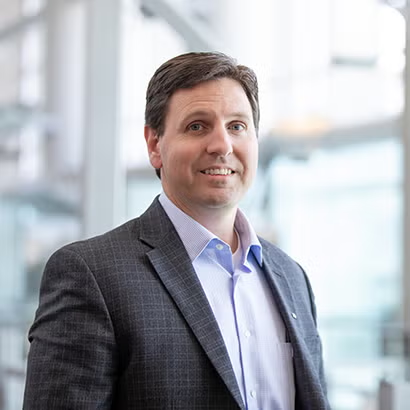
Carlos Femmer is a geomatics and remote sensing leader, enterprise drone operations expert, author, speaker, and applied AI for business practitioner. He works to advance how the industry connects drones, LiDAR, survey data, digital twins, and AI workflows to improve decision-making across critical infrastructure, federal, transportation, and AEC environments.
He leads a large enterprise drone program with a nationwide pilot and aircraft fleet, executing mission-critical work across infrastructure, federal, and critical-asset environments.
federal and state contributions
Carlos’s work has shaped how the federal government, state departments of transportation, and the broader engineering community use drones for critical infrastructure. He played a leading role in standing up a drone program for a major federal defense agency, helping shape its governance, training, and operational structure across dozens of installations. He contributed to a state department of transportation’s official drone bridge inspection manual, a document that now governs how drone inspections are performed across that state’s bridge program. His methodology has moved from the field into the standards.
field firsts
His field work has established precedent at some of the most consequential sites in the country. He led first-of-kind drone inspections of a major suspension bridge and a national park corridor, and has performed drone operations at federal defense and historic military installations. He has delivered digital twin work for a major federal academy, helped with emergency digital twin response following a rail infrastructure failure, and combined drone capture with AI-driven crack detection at a large dam facility, a preview of where critical infrastructure inspection is heading. Each of these projects has been presented publicly, with appropriate client authorization, at leading industry conferences.
The locations may get attention, but the real thread is innovation—doing the kind of work that had not been done that way before.
See the case studies →
at the founding of autonomous operations
Carlos’s career began at a different kind of inflection point. From 1999 to 2002, he worked at C&C Technologies — the Lafayette, Louisiana offshore survey company founded in 1992 by brothers Thomas and Jimmy Chance, sons of the legendary John E. Chance — where he was part of the team that developed and deployed the first commercial autonomous underwater vehicle in the world. The AUV operated in the Gulf of America for oil and gas clients, in some of the most demanding underwater environments on the planet. C&C TECHNOLOGIES was later acquired by Oceaneering, one of the largest offshore services companies in the world. The lesson of that work was the same lesson his father had brought home from the Air Force: when you’re working on something that has never been done, the discipline is everything.
executive path
After C&C, Carlos served as Vice President, Chief Operating Officer, and President of an international aerial and conventional survey company. He built and scaled the operational infrastructure that delivers geospatial work at enterprise volume — managing field crews, P&L, international operations, and the systems that turn raw data into engineering deliverables. That executive arc shapes how he leads in the field today: drone programs are businesses, not flight schedules. Survey is a discipline, not a deliverable.
industry voice
His work has put him on the industry’s most credible stages. Carlos has delivered the keynote at Commercial UAV Expo — the largest commercial drone conference in the world — and has spoken at Trimble Dimensions, Autodesk University, and Geo Week, the flagship events for the geospatial, AEC, and built-environment industries. He has also presented at USSD (the U.S. Society on Dams) and IHEEP (the highway engineering exchange program), where the owners and regulators of America’s critical infrastructure gather.
what he builds
In addition to his professional work in geomatics and remote sensing, Carlos is the author of the UAV Mentor book series, training the next generation of pilots; creator of The Operator Brief newsletter, sharing practical AI knowledge for working professionals who want to integrate AI into real workflows and go deeper into drone operations; and co-founder of 100 For Life with his wife, Tabitha, a 100-day discipline system built on 10 daily pillars, designed to make elite performance repeatable.
His work sits at the intersection of three pillars most people treat as separate: enterprise drone operations, applied artificial intelligence for business, and human performance. Carlos believes they are the same problem viewed from different altitudes.
THE AVIATION BEGAN EARLIER
One Generation Back, the Sky
Was Still Being Mapped.
The work didn’t start with Carlos. His father, William Henry Femmer, first served his country in the United States Navy during World War II. After the war, he continued that path of service and aviation, graduating from us air force Pilot Training Class 48-C — one of the earliest pilot classes of the newly independent United States Air Force.
Class 48-C came at a defining moment in American military aviation. The country was moving out of the World War II Army Air Forces era and into the modern U.S. Air Force, which had only existed as an independent service branch since September 1947.
As Berlin was being airlifted, NATO was being formed, and the institutional shape of American air power was still being decided, his father was learning to fly inside a service that was learning to exist. Disciplined airmanship in an organization where the systems hadn’t yet been written — that was the inheritance Carlos was inspired by.
The lesson wasn’t about flying. It was about doing the work seriously when the methodology was still being defined. Six decades later, Carlos would build enterprise drone programs at the same kind of inflection point — when the sensors, the regulations, and the deliverables hadn’t yet been standardized. The aviation began earlier. The throughline runs through both generations.
Major William Henry Femmer, USAF (Ret.) · Pilot Training Class 48-C. One of the earliest pilot classes of the newly independent United States Air Force. view the historical record at the national museum of US air force.
One of the earliest pilot classes of the newly independent United States Air Force.
THE OPERATING THESIS
Elite performance is a system,
not a talent.
Whether you’re flying a complex bridge inspection, building an AI-augmented workflow, or showing up for the hundredth day in a row — the principle holds.
BEYOND THE WORK
Husband. Father. Grandfather.
Carlos has been married to his high school sweetheart since the beginning, and the family they have built together remains the foundation underneath everything else. Based in Louisiana, he holds an MBA from Louisiana State University and lives by a simple operating order: faith, family, discipline, and field experience — in that order, every day. Everything he writes, builds, and teaches is in service of the next generation: the operators, the professionals, the parents, and the people willing to show up and do the work.
A personal note.
The ideas, frameworks, and opinions on this site are entirely my own. They are written from my own field experience, research, and thinking, not in any official capacity for, or representation of, my current or past clients, partners, or organizations I have been associated with.
Specific projects referenced on this site have been presented publicly, with client authorization, at industry conferences including Commercial UAV Expo, Trimble Dimensions, Autodesk University, Geo Week, USSD, and IHEEP. Anything discussed here is in the public domain.
This site is independent. The work it reflects is independent. The reader is reading me, not anyone else.
the record