
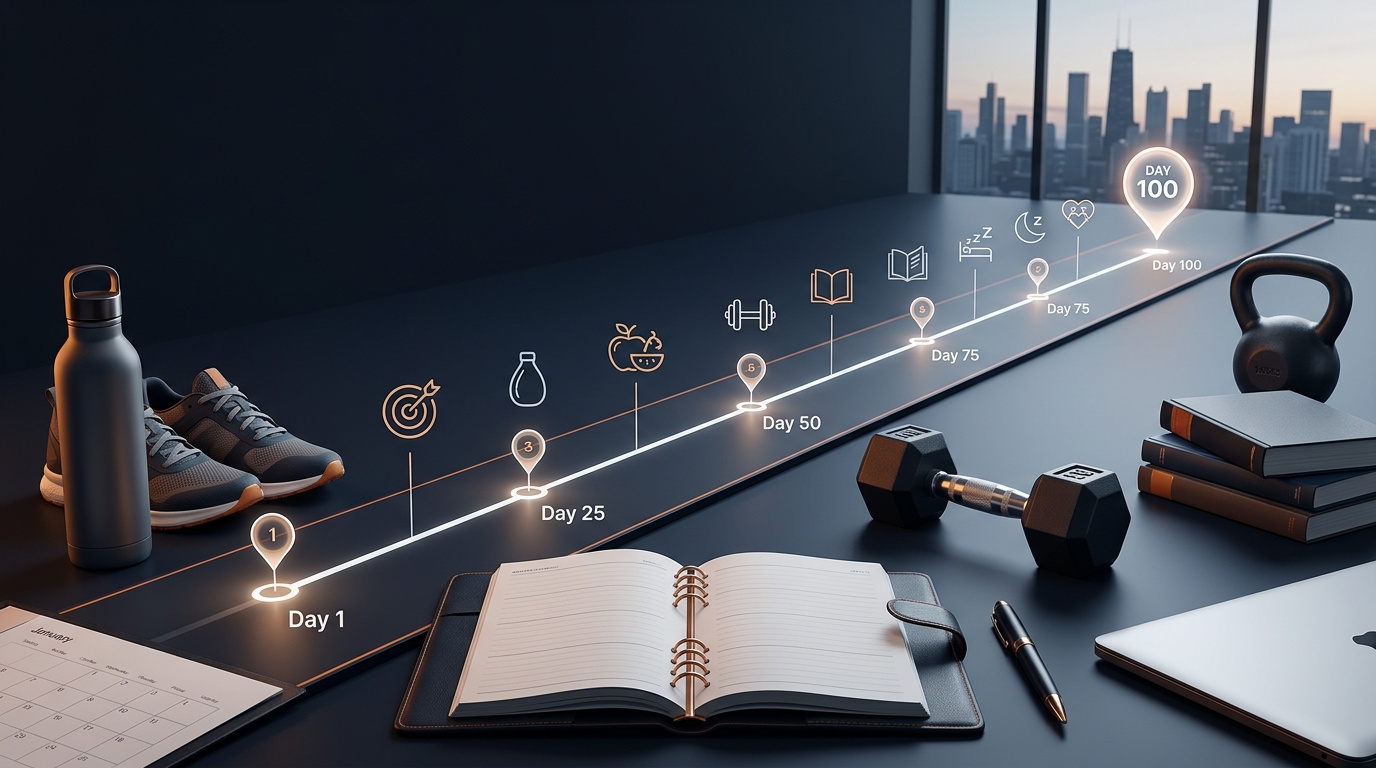
100 For Life: The 100-Day Discipline System for Working Professionals
100 For Life is a 100-day discipline system built on 10 daily pillars — goal setting, hydration, no alcohol, nutrition, daily workouts, 100 miles per month, feeding the mind, journaling, sleep and recovery, and connection — designed to transform the body, sharpen the mind, and elevate professional output. It is not a fitness program. It is not a habit tracker. It is an operating system for working professionals who have decided that the version of themselves they are showing up as is no longer good enough.
The 100-day commitment is the system. The 10 daily pillars are the inputs. The compounding output is the person you become.
Why This Guide Is Different
I lead enterprise drone operations at a large aec firm, where I am responsible for 90+ certified pilots and a 50+ aircraft fleet. I have led drone operations over throughout my career at the Golden Gate Bridge, Pearl Harbor, the Grand Canyon, Vandenberg Space Force Base, and West Point. I am also the author of uav mentor books series and Applied AI for Business.
None of that is the most important thing in my life. My wife, Tabitha, and I have been married for 29+ years. We have four children — George, Carlos, Isabel, and Antonio — and four grandchildren — William, Mary, Shep, and James. Our life is built around faith, family, and growth. 100 For Life is the system that makes everything else possible. Tabitha and I built it together. We are running it together. We are documenting it together.
This is not a guide written by a fitness coach or a habits author. It is written by a working professional with a serious career, a real family, and a long marriage — using the same system I am asking you to use. If you are looking for an extreme transformation challenge designed for someone with no responsibilities, this is not it. If you are looking for a discipline system that fits inside a real life and produces compounding results across decades, you are in the right place.
Why 100 For Life Exists
Most discipline systems fail working professionals for the same set of reasons.
They are too short. Thirty-day challenges create initial momentum and then quietly end. Twenty-one days does not change a person. The research on habit formation that produced the “21 days” myth was misread for decades; the real timeline for durable behavior change runs much longer. Working professionals do not need another 30-day reset. They need a system long enough for actual change.
They are too narrow. Most systems address one domain — fitness, or productivity, or nutrition, or mindset. Real performance is multivariate. A professional who is fit but exhausted, disciplined but isolated, focused but unhealthy, will not sustain elite output. The system must address the whole human or the gains do not compound.
They are too extreme. The transformation industry has trained working professionals to think discipline means cold plunges at 4 a.m., 75 hard challenges, and content designed for people whose entire job is documenting their discipline. Working professionals with careers, marriages, children, and responsibilities cannot run that protocol — and should not. We need a system that produces elite results while remaining executable inside a real life.
They are too dependent on motivation. Motivation is a state, not a strategy. Systems that require daily motivation collapse the first week motivation runs out. The systems that work are systems that operate even when you do not feel like running them.
100 For Life was built to address all four. One hundred days is long enough for change to become identity. The 10 pillars cover the whole human. The protocol fits a working professional’s life. The system runs on commitment, not motivation.
Why 100 Days, Specifically
The duration is not arbitrary. One hundred days is the smallest unit of time large enough to produce three things simultaneously.
Identity change. Behaviors practiced for 100 consecutive days stop being things you do and start being things you are. The professional running Day 87 of 100 For Life is not the same person who started Day 1 — and the change is durable, not borrowed motivation that will fade after the program ends.
Compounding evidence. Most professionals never see the compounding effect of consistent discipline because they quit before the curve bends. Days 1 through 30 produce visible effort with limited visible result. Days 30 through 60 produce momentum. Days 60 through 100 are where the compounding shows up — in the body, in the mind, in the work, in the relationships. Quitting at Day 30 means never seeing what your own discipline can actually produce.
Operational durability. A system that survives 100 consecutive days of real life — work travel, sick kids, hard weeks, holidays, family obligations, professional crises — is a system that will survive forever. One hundred days is the proving ground that turns a program into an operating system.
Thirty days produces a story. One hundred days produces a person.
The 10 Daily Pillars
Every day of 100 For Life, you execute the same 10 pillars. They are not optional. They are not seasonal. They are not negotiable. The discipline is the daily execution of all 10, every day, for 100 consecutive days.
Pillar 1: Set Goals (Fitness, Personal, Business)
Write the vision. Live with intention.
You cannot run a system without a destination. Pillar 1 is the daily practice of writing your goals across the three domains that matter — physical, personal, and professional — and operating the day from those written commitments rather than from drift. Working professionals who do not write their goals down execute other people’s priorities. Working professionals who do, execute their own.
Pillar 2: Hydration Discipline
Fuel the machine.
The body is the platform on which every other capability runs. Dehydration silently degrades cognitive performance, physical output, and decision quality. Hydration discipline is the daily, deliberate intake of water as a non-negotiable input — not a thing you remember when you feel thirsty. Track it. Hit the target. Every day.
Pillar 3: No Alcohol
Choose clarity.
This is the pillar that filters serious commitment from casual interest. Alcohol degrades sleep quality, recovery, decision-making, body composition, and emotional regulation — and it does so in ways most professionals have stopped noticing because it is the cultural default. One hundred days without alcohol is one hundred days of a sharper, faster, more present operator. The clarity that returns is not subtle. The professionals who run this pillar honestly discover what they had been giving up.
Pillar 4: Follow a Nutrition Plan
Eat with purpose.
Not a diet. A plan. Working professionals who eat reactively — whatever is available, whatever is convenient, whatever the calendar drove them to — perform reactively. A nutrition plan, executed daily, removes hundreds of small decisions from the day and replaces them with one decision made once: this is what fuels the machine. The plan can be flexible. The discipline of having one cannot be.
Pillar 5: Daily Workout
Move every day.
Every day. Not most days. Not weekdays. Not when scheduled. Every day. The workout does not have to be heroic; it has to be honest. A 30-minute walk on a travel day counts. A full strength session on a normal day counts. The point of daily movement is not athletic performance — it is the daily reminder that your body is the platform you depend on for everything else, and you treat it accordingly.
Pillar 6: 100 Miles Per Month
Progress, step by step.
The cumulative pillar. One hundred miles per month — running, walking, hiking, or a combination — is the unit of measurable physical progress that compounds across the 100 days. By the end of the program, you have moved over 300 miles. That mileage is not just fitness; it is the visible evidence that small daily inputs produce large monthly outputs. The lesson of Pillar 6 is the lesson of every system that compounds: show up daily, track honestly, and the math will deliver the result.
Pillar 7: Feed the Mind
Protect the mind.
What you put into your mind every day determines the operator you become. Feeding the mind is the daily practice of consuming intentionally — books, scripture, long-form content, professional development — instead of consuming whatever the algorithm serves you. Equally important is what you do not consume. Protecting the mind from low-quality input is half the pillar. The professionals who run this pillar honestly notice their thinking change within weeks.
Pillar 8: Journal the Journey
Track the truth.
The daily journal is the system’s accountability layer. Writing what you did, how you felt, what worked, and what did not, every day, creates a record of the truth that memory cannot. Working professionals who journal during 100 For Life have documentation of the version of themselves they were becoming. Working professionals who do not, have a story they are telling themselves that may or may not match reality. The journal is the evidence.
Pillar 9: Sleep & Recovery Discipline
Recovery is strategy.
Sleep is not a personal weakness or a productivity inconvenience. It is a strategic input. Working professionals chronically under-recover and then wonder why their output, mood, and decision quality are inconsistent. The sleep and recovery pillar is the daily commitment to the duration, the timing, and the protective behaviors that protect recovery — bedtime discipline, screen discipline, environmental discipline. Every elite operator I know treats sleep as professional infrastructure. So should you.
Pillar 10: Connection & Relationships
Protect your people.
The final pillar is the one most discipline systems ignore entirely — and the one that determines whether everything else has any meaning. Daily, intentional connection with the people who matter — spouse, children, family, close friends, faith community — is the pillar that keeps the system human. A professional who runs nine pillars at elite level and lets relationships erode is running the program wrong. The system exists to make you a better operator, but also a better partner, parent, and person. Pillar 10 is where the work is for. Tabitha and I built 100 For Life together because we believed any system that makes you better at your career while costing you your family is not a system worth running.
Why These 10 and Not Others
Every pillar is in this system because of what it does for the operator running it.
Pillars 2 through 6 govern the body — the platform every other capability depends on. Without physical foundation, every other domain degrades. Pillars 7 and 9 govern the mind — feeding it, protecting it, recovering it. Without mental clarity, professional output ceases to compound. Pillars 1 and 8 govern intentionality — without written direction and honest tracking, the days drift and the system collapses. Pillar 10 governs meaning — without the people you love, the rest is empty.
Most systems pick one or two of these and call it a discipline framework. Working professionals need all 10. Drop any pillar and the others become harder to sustain. Run all 10 and they reinforce each other. That is the system.
Why Discipline Is a Professional Skill, Not a Personality Trait
Most working professionals treat discipline as something other people have. They watched a documentary. They read a book. They concluded that discipline is the genetic gift of military operators and elite athletes — and that they, as ordinary professionals, do not have access to it.
This is wrong, and it is expensive.
Discipline is a professional skill. It is built the same way every other professional skill is built — through deliberate practice, structured systems, and consistent execution over a long enough horizon to produce results. The drone pilots I lead who have the highest field performance are not the most talented. They are the most disciplined. The professionals in my Applied AI for Business community who advance the fastest are not the most technical. They are the most disciplined. The pattern is consistent across every domain I have ever operated in.
The reason this matters for your career is direct: your professional output is downstream of your operating condition. A working professional with a strong body, a clear mind, a stable home, and an intentional daily practice produces dramatically better work than the same professional running on three hours of sleep, alcohol from the night before, no exercise in two weeks, and a marriage that needs attention. The work product is not separable from the operator producing it.
The professionals who internalize this build careers that compound across decades. The professionals who do not, plateau early and then wonder why the people next to them keep advancing.
What 100 For Life Is Not
To preempt the misunderstandings I have heard most often:
It is not a fitness program. Fitness is a byproduct, not the goal. Running 100 For Life will improve your body. It will improve your mind, your work, and your relationships more.
It is not extreme. Compared to 75 Hard, military selection programs, or extreme transformation challenges, 100 For Life is moderate by design. The pillars are demanding daily commitments, not heroic feats. The system was built to be executable inside a working professional’s life, not in spite of it.
It is not a 100-day reset. The program is 100 days. The system is for life. The point is not to complete one round. The point is to use the first 100 days to install an operating system you run for the next 50 years.
It is not motivational content. Nothing in this guide will make you feel inspired. Inspiration runs out around Day 9. What carries you to Day 100 is commitment, structure, and the daily practice of executing the pillars whether you feel like it or not. If you are looking for hype, you are in the wrong place.
It is not the program for someone who already has it figured out. It is the program for working professionals who are honest about where they are, clear about where they want to be, and willing to do the daily work for 100 consecutive days to close that gap.
The Mistakes That Cause People to Quit Before Day 100
In running this system and watching others run it, the failure patterns are consistent.
Treating it as a sprint. People who attack the first week with maximum intensity collapse by Week 3. The professionals who finish are the ones who pace from Day 1, knowing the work is daily for 100 days.
Running it alone. Discipline is harder in isolation. The professionals who finish run with someone — a spouse, a friend, a small group, a community. Tabitha and I run it together. The mutual accountability is part of the system, not an accessory to it.
Skipping pillars. Working professionals try to negotiate down to “the pillars I think matter.” This is not how the system works. The 10 pillars are integrated. Skip Pillar 9 and Pillar 5 degrades. Skip Pillar 3 and Pillar 7 degrades. Run all 10, every day, for 100 days. That is the protocol.
Confusing perfection with consistency. A missed day is not a program failure. A missed day handled honestly — acknowledged in the journal, restarted the next morning — is part of the program. A missed day used as an excuse to abandon the rest of the week is the failure mode that ends most attempts.
Treating the journal as optional. Pillar 8 is the one most professionals try to skip and the one most predictive of who finishes. The journal is the system’s truth-tracking mechanism. Without it, you are running the program from memory, and memory lies.
Ignoring relationships. Professionals who isolate to “focus on the program” miss the entire point. Pillar 10 is not optional. The system is built so the people you love benefit from the work, not so they pay the cost of it.
How 100 For Life Connects to the Rest of Your Life
This is the part most discipline systems do not address — and the part that separates 100 For Life from anything else you have read.
The pillars are not just personal practices. They are the operating layer beneath every other capability you are trying to build.
If you are building a professional drone career, the discipline that gets you to Stage 4 of the Operator Stack is not different from the discipline of 100 For Life. It is the same discipline. The pilots who advance are the pilots who run their lives the way they run their flights — systematically, daily, with no shortcuts. The system is the system.
If you are integrating Applied AI for Business into your career, the discipline that takes you through the five-stage AI integration roadmap is the same discipline. The professionals who reach the system-building and organizational integration stages are not technically gifted; they are operationally consistent. They run their AI practice the way 100 For Life runs the body and mind — every day, with structure, for long enough to compound.
If you are building a business, leading a team, or simply trying to be a more present spouse and parent, the answer is the same. Elite performance is a system, not a talent. The 100 For Life pillars are the system underneath everything else.
This is why the program exists. Not to produce abs in 100 days. To produce the operator capable of running every other system in their life at a level that compounds across decades.
Your First 100 Days
If you are starting Day 1 today, here is what the next 100 days look like.
Days 1–14: Installation. The first two weeks are about installing the 10 pillars as daily non-negotiables. Expect friction. Expect the pillars to feel awkward and over-engineered. Trust the protocol. Run all 10, every day, no negotiations, no skipping. The point of the first two weeks is not optimization; it is execution.
Days 15–35: Resistance. The honeymoon ends around Week 2. This is when the work feels heaviest, results feel invisible, and the professional in you starts negotiating reasons to scale back. Do not. Honor the protocol. Trust the system. The professionals who survive this phase are the professionals who finish.
Days 36–65: Integration. Around Day 36, the pillars stop feeling like things you have to remember and start feeling like things you do automatically. Mileage starts compounding. Sleep stabilizes. Work output sharpens. The journal entries get shorter because the system is running cleaner. This phase is the longest and the most important. Maintain the protocol exactly.
Days 66–90: Compounding. This is where the math shows up. Body composition has changed. Mental clarity is no longer subtle. Work output has measurably improved. Relationships are stronger because Pillar 10 has been run for 60+ days. Professionals at this stage often describe themselves as feeling like a different person. They are. That is identity change, and it is durable.
Days 91–100: Identity. The final ten days are not about pushing through. They are about recognizing what has happened. The version of yourself crossing Day 100 is not the version that started Day 1. The journal documents the change. The mileage documents the change. The body, the mind, the work, the relationships — all document the change. Day 100 is not the finish line. It is the launch point.
After Day 100, you do not quit. You run the system again, and again, and again, with refinements, for the rest of your life. That is why it is called 100 For Life.
Frequently Asked Questions
What is 100 For Life?
100 For Life is a 100-day discipline system built on 10 daily pillars — goal setting, hydration, no alcohol, nutrition, daily workouts, 100 miles per month, feeding the mind, journaling, sleep and recovery, and connection — designed to transform the body, sharpen the mind, and elevate professional output. It is created and run by Carlos Femmer and Tabitha Femmer, and it is built specifically for working professionals.
Why 100 days and not 30 or 75?
One hundred days is the smallest duration long enough to produce identity change, visible compounding evidence, and operational durability through the realities of working life. Thirty days produces a story, not a person. Seventy-five days is closer but still ends before the deepest compounding shows up. One hundred days is the duration at which behaviors stop being things you do and start being things you are.
What are the 10 pillars of 100 For Life?
The 10 pillars are: 1) Set Goals across fitness, personal, and business domains; 2) Hydration Discipline; 3) No Alcohol; 4) Follow a Nutrition Plan; 5) Daily Workout; 6) 100 Miles Per Month; 7) Feed the Mind; 8) Journal the Journey; 9) Sleep & Recovery Discipline; 10) Connection & Relationships. Each pillar is run every day for 100 consecutive days.
Is 100 For Life similar to 75 Hard?
Both programs use a daily-execution structure, but the systems are designed for different people and different outcomes. 75 Hard is a mental toughness challenge with a fixed protocol. 100 For Life is a complete operating system with 10 pillars covering body, mind, intentionality, and relationships, designed for working professionals to integrate into a real life with career, family, and long-term commitments. 100 For Life addresses connection and relationships explicitly, includes intentional mind input, and is built for sustained life integration rather than as a single challenge.
Do I need to be physically fit to start 100 For Life?
No. The system meets you at your current condition. The daily workout pillar is calibrated to honest effort, not athletic performance. The 100-miles-per-month pillar can be walked, hiked, or run. Working professionals who start the program out of shape often see the largest transformations because the compounding has more room to run.
Can I drink alcohol during 100 For Life?
No. Pillar 3 — No Alcohol — is non-negotiable for the full 100 days. This is the pillar that filters serious commitment from casual interest. Working professionals who attempt to negotiate this pillar consistently fail to finish the program. The clarity that returns from 100 alcohol-free days is one of the most reported transformations from the system.
What if I miss a day?
Acknowledge the missed day honestly in your journal, identify what caused it, and resume the protocol the next morning. A single missed day is not a program failure; it is a data point. The failure mode is using a missed day as an excuse to abandon the rest of the week. The system is built to absorb honest imperfection while rejecting dishonest negotiation.
Can I do 100 For Life with a spouse, friend, or group?
Yes — and the professionals who finish almost always run it with at least one other person. Tabitha and I built 100 For Life together specifically because mutual accountability is part of the system, not an accessory. Running it with a spouse, close friend, or small accountability group meaningfully increases the probability of completion.
Is 100 For Life religious?
The system is not religious in its protocol, but it is built on values consistent with our faith — discipline, family, intentional living, and growth. Pillar 7 (Feed the Mind) and Pillar 10 (Connection & Relationships) explicitly support spiritual and faith practice for those who want to integrate it. The system is designed to be executable by any working professional regardless of faith background.
How does 100 For Life relate to professional performance?
Directly. Your professional output is downstream of your operating condition. A working professional with a strong body, a clear mind, a stable home, and a daily practice of intentional execution produces dramatically better work than the same professional without those inputs. The 10 pillars are the operating layer beneath every other system you are trying to build — career, business, relationships, family. That is why 100 For Life is built specifically for working professionals.
What happens after Day 100?
You run the system again. The program is 100 days. The system is for life. The first 100 days install the operating system. The rest of your life runs on it, with refinements, repetitions, and lifelong commitment. Working professionals who complete one round and then abandon the system give back most of what they built. Working professionals who run it as the lifelong system it was designed to be are the ones who compound across decades.
What to Do Next
If this guide gave you a clear picture of what the system is and what it asks of you, the next step is committing to your first 100 days deliberately.
The full 100 For Life program — the daily protocol, the pillar-by-pillar implementation guidance, the journal structure, the community of working professionals running it alongside you, and the app that Tabitha and I built to track all 10 pillars in one place — is being launched soon. Subscribe to The Operator Brief for early access and the exact launch date.
If you are using the 100 For Life discipline system to fuel a professional career in drone operations, the UAV Mentor book series provides a practical roadmap for working professionals who want to understand the path from FAA Part 107 certification to advanced, enterprise-level drone operations.
If you are integrating AI into your career, Applied AI for Business is the structured curriculum that takes working professionals through the five stages of AI integration — and runs on the same daily discipline that 100 For Life is built around.
The work is daily. The horizon is long. The compounding is real.
Elite performance is a system, not a talent. 100 For Life is the system. The next 100 days will tell you what you are capable of.
Carlos Femmer leads enterprise drone operations, managing 90+ FAA Part 107 pilots and a fleet of more than 50 aircraft. He is the co-founder of 100 For Life with his wife, Tabitha, the creator of Applied AI for Business, and the author of the UAV Mentor book series. Carlos and Tabitha have been married for more than 29 years. Together, they are parents of four and grandparents of four. He writes from real-world field experience — not theory.